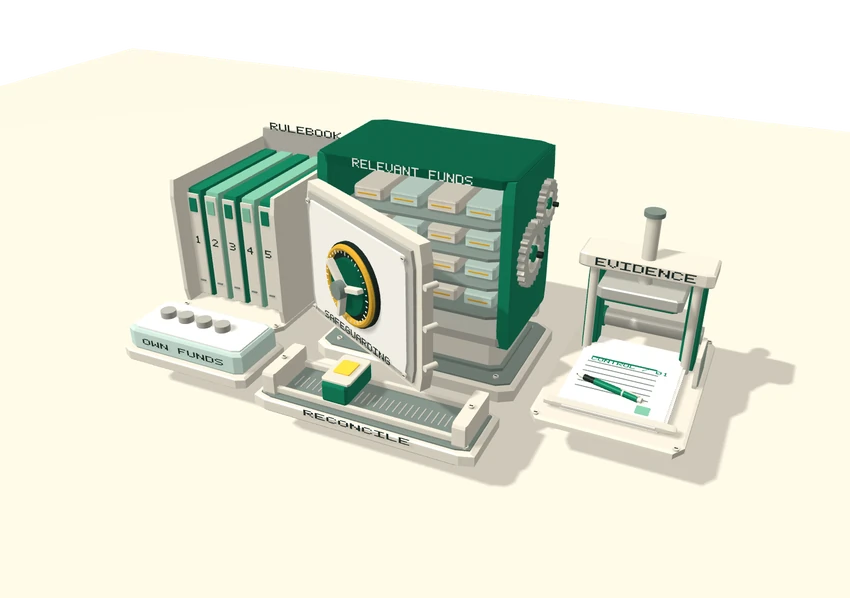
The operating answer
The Supplementary Regime took effect on 7 May 2026. Start by confirming whether the firm and activity are in scope, then map each obligation to an owner and retrievable evidence. The end-state, Post-Repeal Regime is a separate project; do not treat the two as interchangeable. [FCA]
The workflow below is our editorial synthesis. Regulatory statements link to primary sources. Examples are hypothetical, and applicability requires a firm-specific assessment.
The first decision is scope
Before replacing a policy, describe the legal entity, its status, the service and the funds it receives. That short description is the front page of the file. It should make it possible for a reviewer to distinguish payment services from e-money issuance, and regulated activity from other work carried out by the same group.
The FCA's policy statement identifies the institutions covered and specific exceptions. Use that list alongside the applicable Handbook provisions. A group presentation saying “we are a payments business” does not settle which entity has the obligation. Write down the answer for each service, with the rule reference and the person who approved the interpretation. [FCA]
If the answer depends on a contract, a settlement arrangement or a bank-account title, include that document in the file. Record uncertainty explicitly. An unresolved perimeter question belongs on the decision log, not underneath a green completion status.
Draw the ledger before designing the dashboard
Build an inventory of the records used to identify relevant funds. List the customer ledger, payment events, settlement accounts, provider statements and adjustments. For every feed, record the entity, currency, time zone, reporting cut-off and whether the amount is gross or net. This is an editorial working method, not a prescribed reporting template.
A transaction identifier should survive across the journey. Where systems use different identifiers, preserve the mapping. Reconciliation becomes fragile when the only join is an amount and a date, particularly where batches contain refunds, fees or multiple currencies.
Ask the finance and operations teams to trace one ordinary receipt and one exception from the originating event to the final entry. A clean example proves that the normal path can be followed. The exception shows whether the records remain intelligible when a transfer arrives late, a provider file is revised or a customer payment is returned.
Make the reconciliation reproducible
The current safeguarding framework includes internal and external reconciliations at least once each reconciliation day. The current rules, rather than a generic calendar-day assumption, determine the obligation. The FCA also highlights due diligence, resolution packs, audits and monthly reporting. [FCA]
For each run, retain the inputs as they existed when the run was performed. Preserve the calculation, the list of exclusions and the basis for each adjustment. A reviewer should be able to reproduce the reported result without asking the original operator to remember which spreadsheet was used.
Separate the calculation from the explanation of a break. A note saying “timing” is a hypothesis. Add the transaction identifier, expected settling event, owner and follow-up point. If the event does not occur, the item should return to active investigation rather than age quietly in an exception tab.
The reconciliation worksheet on this site illustrates arithmetic only. It cannot classify funds, identify the applicable method or decide which assets are eligible. Those are prerequisites supplied by the firm, not outputs produced by the calculator.
Treat breaks as work, not annotations
A useful break record has a beginning and an end. At the beginning, capture how the item was detected, its value, the affected customers or ledger population, and the immediate question. At the end, preserve the correction, the evidence that it worked, and the reviewer who accepted closure.
Avoid combining unrelated differences simply because their net amount is small. Two opposite errors can cancel numerically while still leaving the customer records wrong. Track each material explanation separately and show the net position only as an additional view.
Set internal escalation points deliberately. The illustrative owner and review schedule in a playbook is not a substitute for a regulatory deadline or a firm's incident-notification duties. Where an obligation may have been breached, the appropriate compliance and legal decision should be recorded alongside the operational repair.
Third-party evidence has to match the entity
Create an account inventory with the legal holder, provider, purpose, currency, opening date and relevant documentation. A familiar bank brand is not an adequate substitute for the exact contracting entity. The inventory should explain which account supports which service and which control owner confirms that the information is current.
Retain the relevant agreements and correspondence in a controlled location. If documents sit only in an employee's inbox, the process depends on that employee being available during a failure or review. Test retrieval by asking someone who did not create the file to find an agreed sample.
For a third-party change, record both the intended cut-over and the actual transition. Old and new accounts may both appear in the records for a period. The control file should explain that overlap rather than letting it look like an unexplained duplication of funds.
Build reporting from the underlying records
SUP 16.14A sets a monthly safeguarding return deadline of 15 business days after month-end, with an exception for the month in which an institution becomes a safeguarding institution. Check the live rule and submission instructions for the firm's position. [FCA Handbook]
Work backwards from the reporting date to an internal preparation, review and sign-off sequence. Those internal milestones are planning choices. Label them as such. A preparer should know where every reported value came from and which version was approved.
Keep a bridge between the daily operational records and the monthly output. Unexplained differences between them can be more informative than an apparently complete report. When the source dataset changes after sign-off, preserve the original and document the assessment of whether a correction is required.
Resolution and assurance are different tests
A resolution pack asks whether information can be retrieved and used when the institution is in difficulty. An assurance exercise asks whether the arrangements satisfy its defined criteria over the period tested. One organised folder cannot, by itself, demonstrate that both outcomes have been achieved.
For retrieval testing, remove the assumptions of the normal office day. Can an authorised substitute find the current account inventory? Can they identify the latest reconciliation and unresolved exceptions? Can they understand the record without access to an individual's private notes?
For audit planning, confirm applicability, scope and period against the relevant rules. SUP 3A includes provisions on institutions and exemptions; this page does not assume that every firm has the same audit requirement. The audit scoping decision and its supporting facts should be easy to locate. [FCA Handbook]
Close the implementation with a dry run
Choose a completed operating day. Ask a colleague who did not prepare it to trace the source data, the classification decisions, the reconciliation and any unresolved difference. Then ask them to identify how that day would feed the monthly return and the resolution information.
Record where the exercise fails. “The file exists” is not enough when the reader cannot identify the entity, date or units. Fix the control or the documentation and repeat the relevant step. Keep both attempts so that the improvement has a visible history.
The release decision should name the owner of the ongoing process, not just the owner of the implementation project. It should also identify the events that trigger a fresh review: a new service, a changed settlement path, a provider change or a material systems release. These triggers keep the operating file connected to the business after launch.
| Evidence | What it should establish | Suggested owner |
|---|---|---|
| Scope record | Entity, service and applicable provisions | Compliance |
| Data dictionary | Meaning, timing and origin of each input | Finance / data |
| Break log | Cause, value, action and closure evidence | Operations |
| Reporting bridge | Traceability from records to return | Finance |
| Retrieval test | Usability without the original preparer | Independent reviewer |
Working checklist
Progress is saved only in this browser when local storage is available. Ticks record your work; they are not a compliance score.
Method, assumptions and limits
We use official sources for regulatory facts and label our suggested workflows as editorial methods. Illustrative examples are hypothetical. The content does not establish the position of any individual firm and is not a prescribed regulator template.
Source review date: 12 November 2026. No automatic monitoring is running. Check the underlying document, applicable entity, activity and jurisdiction before using this material.
Read the full methodologyQuestions, answered.
Is safeguarding the same as FSCS deposit protection?
No. They are different protection mechanisms. Read the safeguarding-versus-FSCS explainer and check the exact product and provider.
Does this page determine which funds are relevant?
No. The firm must make a documented classification using its activities, agreements and applicable rules. The worksheet assumes that classification has already been made.
Are the internal milestones regulatory deadlines?
No. Playbook milestones are editorial planning suggestions unless explicitly linked to a dated primary rule.
Sources & scope
Primary sources used for this research edition. Document dates and commencement dates are different fields. Recheck the issuing authority before acting.
- FCA: PS25/12: safeguarding reformPolicy statement · source reviewed 12 November 2026
- FCA: Safeguarding requirements for payment and e-money institutionsGuidance · source reviewed 12 November 2026
- FCA Handbook: CASS 15: relevant fundsHandbook · source reviewed 12 November 2026
- FCA Handbook: SUP 16.14A: safeguarding returnHandbook · source reviewed 12 November 2026
- FCA Handbook: SUP 3A: safeguarding auditsHandbook · source reviewed 12 November 2026
- FCA: Payments and e-money: key publications and current Approach DocumentSource library · source reviewed 12 November 2026